



The Shadow Tax of Outsourcing
Why Over-Reliance on IT Vendors Is Costing You More Than You Think
By MAXX Potential
- Posted:
- Businesses

Most CIOs calculate vendor costs by the hour. But the real bill arrives later in the form of lost institutional knowledge, eroded leverage, and an organization that no longer owns its logic.
Pull up any vendor invoice and the math should look clean. It’s all there: an hourly rate, a headcount, and a contract term. Check the math: multiply through, compare to budget, and move on. The cost picture seems clear.
It isn’t.
Hidden beneath every outsourced technology engagement is what we call the Shadow Tax. This accumulating, invisible charge compounds with every contract renewal, vendor rotation, and workstream surrendered to an external team. By the time most technology leaders notice it, it has already reshaped their organization in ways that are difficult to reverse.
This post is about what the Shadow Tax actually costs, how it accumulates, and why the answer isn’t another vendor — it’s a fundamentally different kind of partnership.
How the Shadow Tax Accumulates
The Shadow Tax isn’t a line item. It’s a structural condition that builds across three dimensions. None of which appear on a standard invoice.
1. What leaves when the contract ends
Every engineer who works inside your systems learns something that isn’t in the documentation. Perhaps they learn or create a workaround when something doesn’t work quite right. It’s the undocumented dependency between two services that predates three platform migrations or the judgment calls baked into code that nobody remembers writing.
When an external engineer carries that knowledge, it belongs to the engagement, not the organization. When the contract ends or the team rotates, that understanding walks out the door. What follows is a re-onboarding cycle: slow, expensive, and invisible on any budget report. In “The Hidden Costs of IT Outsourcing” with MIT Sloan Management Review, research across 50 outsourcing engagements found that companies are largely unaware of the costs tied to vendor transitions and that the average transition alone takes a full year to complete.
In application maintenance, DevOps support, and QA — the high-volume, operationally critical areas where outsourcing is most common — this knowledge loss compounds the fastest. Each rotation erases a layer of context that the next team must reconstruct.
2. Structural dependency erodes your negotiating position
Heavy vendor reliance doesn’t just cost money; it costs negotiating power. When a vendor holds the institutional knowledge for a critical workstream, switching vendors becomes more challenging even when performance disappoints. The cost of leaving exceeds the cost of staying, regardless of contract terms.
Over time, this dynamic inverts the commercial relationship. Vendors who once competed for your business now hold structural leverage over renewal conversations. Scope expansions that should be competitive become single-source by default. The organization loses the ability to do something that should always be available: pit vendor capacity against internal capacity, or break large engagements into smaller, more competitive pieces.
The data reflects how widespread this recognition has become. In the Deloitte 2024 Global Outsourcing Survey, seventy percent of executives report having selectively brought work back in-house that was previously held by a third party — and the reasons they give are instructive: 68% cite better control over service quality, 64% cite building strategic capabilities internally, and 56% cite eliminating vendor markup costs. These aren’t abstract concerns. They are the Shadow Tax being recognized, after the fact, on balance sheets and in contract renewal rooms.
3. Your best engineers are managing vendors, not building things
The third cost is the hardest to see on a budget report: the senior engineering time consumed by vendor relationships themselves.
Someone has to review the external team’s work. Someone has to get the new vendor up to speed on how your systems actually operate. Someone has to bridge the gap between what was promised in the contract and what’s happening in the codebase. That someone is almost always one of your best people.
This isn’t theoretical friction — it is real engineering capacity diverted from modernization, architecture, and the work that actually moves the organization forward. Deloitte found that while companies with mature vendor management functions can achieve 20% or more in cost savings, 70% of organizations admit their vendor management capabilities aren’t fully developed, meaning most are paying the overhead of managing external relationships without the governance infrastructure to contain it.

The Calculation Most Leaders Are Getting Wrong
Most outsourcing decisions are made on hourly rates. That’s the wrong number to be assessing.
The full cost of an external engagement includes the time spent getting each new team up to speed, the senior engineering hours consumed by vendor oversight, and the negotiating leverage quietly surrendered with every renewal. None of those appear on the invoice. All of them are real.
When you factor them in, the gap between external vendor labor and an apprenticeship-model technologist is considerably wider than the hourly rate alone suggests. The same research that found vendor transitions averaging a year in duration identified four categories of hidden cost that consistently erode the anticipated benefits of outsourcing: transition costs, management overhead, search costs, and switching costs. None of which are captured in standard contract pricing.
The good news is that the math works in reverse too. Even shifting a handful of workstreams away from external vendors begins to close that gap, and more importantly, it starts unwinding the structural dependency that makes the Shadow Tax so hard to escape in the first place.
From Managing Vendors to Owning Outcomes
The financial reframe matters, and the deeper shift is organizational.
There is a meaningful difference between a technology organization that manages vendors and one that owns outcomes. Managing vendors is a reactive posture: you are administering someone else’s workforce against your priorities, reviewing external deliverables, and translating institutional context across the gap between inside and outside. Owning outcomes means retaining engineering decision-making, architectural judgment, and delivery accountability within the organization itself.
The signals of this shift are practical and observable. Internal teams can explain why systems work the way they do, not just that they do. Architecture and compliance decisions are driven internally, not delegated. Vendor contracts shrink in scope and increase in competition.
Organizations that develop internal engineering capability while selectively reducing vendor dependence tend to see both cost improvement and stronger delivery outcomes, not because outsourcing is inherently flawed, but because the balance has shifted too far for too long in too many organizations.
The question isn’t whether to use external capacity. It’s whether that capacity is being used in a way that builds institutional strength or quietly erodes it.
Why Partnership Changes the Equation
The instinct, when vendor costs feel high, is to find a cheaper vendor: a different staffing firm, a lower-cost geography, or a new contract structure. This solves the rate problem while leaving the Shadow Tax intact.
What actually changes the equation isn’t a better vendor. It’s a different kind of relationship entirely.
A partner relationship is built around a simple idea: the work should leave your organization stronger than it found it. That means knowledge stays inside when an engagement ends. It means talent is developed within your specific environment, not optimized for someone else’s bench. It means that over time, leverage shifts toward your organization rather than away from it and that the people doing the work can become a permanent part of your team if they’re the right fit.
That’s the structural difference between a vendor and a partner, and it’s the difference between a relationship that compounds the Shadow Tax and one that starts reducing it.
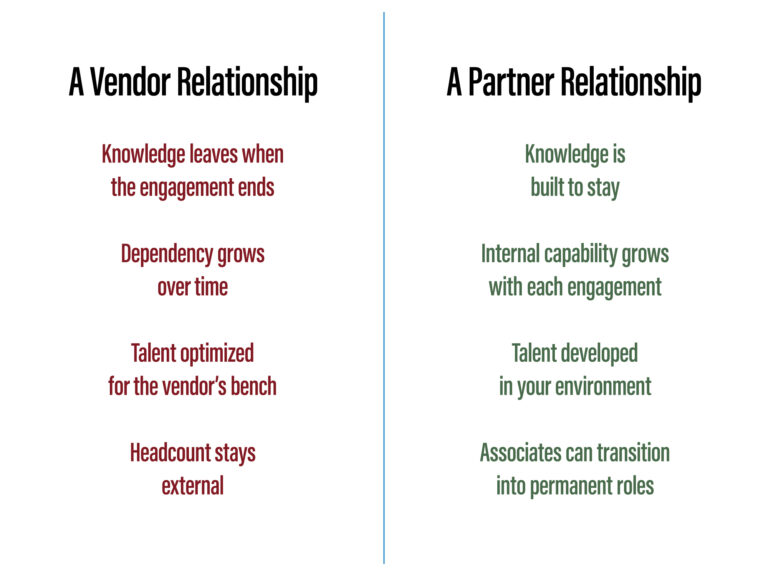
This is what the MAXX Potential model is built around — an invested partnership designed to lower the Shadow Tax from day one and keep lowering it.
How the Apprenticeship Model Works in Practice
MAXX Potential deploys early-career technologists, with the support of an experienced MAXX mentor, onto enterprise technology teams. They work alongside internal engineers, in real operating environments, on real delivery workstreams. The institutional knowledge they develop is learned inside your organization and stays there.
High-performing individuals can transition into full-time roles, building an internal engineering bench that was shaped by your systems, your standards, and your culture from day one.
Primary Value Capture Areas
Legacy Platform Maintenance: Reclaiming senior engineering capacity currently consumed by Unibasic and legacy ERP support — freeing those resources to drive GenAI strategy and modernization initiatives.
Automated Testing Suites: Expanding regression coverage across critical e-commerce and supply chain flows to sustain deployment accuracy at scale, without carrying external consulting margins.
DevOps Internalization: Transitioning CI/CD pipeline management and infrastructure ownership from staff-augmentation vendors to an internal bench built on your standards and tooling.
Incident Automation: Standardizing response workflows to reduce operational debt, improve mean time to resolution (MTTR), and decrease reliance on reactive, high-cost support models.
Standards Compliance: Executing API governance and architectural guardrail initiatives using cost-effective, internally-oriented capacity aligned to your existing engineering standards.
The Execution Path
The entry point is a proof-of-value pilot targeting one or two workstreams where vendor rates are elevated and institutional knowledge risk is material. Measurable outcomes include backlog reduction, documented legacy logic, and associate performance aligned to team velocity within a defined timeframe.
Those results establish the baseline for vendor contract renegotiation — and give your organization a concrete internal alternative to external labor rather than a theoretical one.
The Organizations That Will Win the Next Decade
The technology organizations that will lead in the next decade are not necessarily the ones with the largest vendor contracts. They are the ones that recognized the last several years as an opportunity to rebuild internal capability, to stop renting outcomes and start owning them, to shift from structural dependency toward genuine delivery ownership.
The Shadow Tax doesn’t resolve on its own. Every year of vendor dependency compounds it: more institutional knowledge at risk, more leverage conceded in renewal conversations, more senior engineering capacity absorbed by management overhead.
But it is recoverable. The path forward isn’t a different vendor. It’s a different model — one designed from the start to leave the organization stronger than it found it.
The hourly rate is only half the bill. The question worth asking is what the other half has been costing you, and whether the relationship you’re in is built to make it better, or worse.
Building internal capability takes the right partner. At MAXX Potential, our 100% US-based team works alongside yours — offering Managed Services, Tech Consulting, and more — to create solutions that grow with your organization. Reach out today to get started.
MORE POSTS
Why Over-Reliance on IT Vendors Is Costing You More Than You Think
What One NOC Incident Reveals about Silent System Failures, Managed NOC Services, and After-Hours Coverage Gaps
Why Smart Leaders Focus on Output, Not Headcount